
Listen, subscribe, and leave a review on:




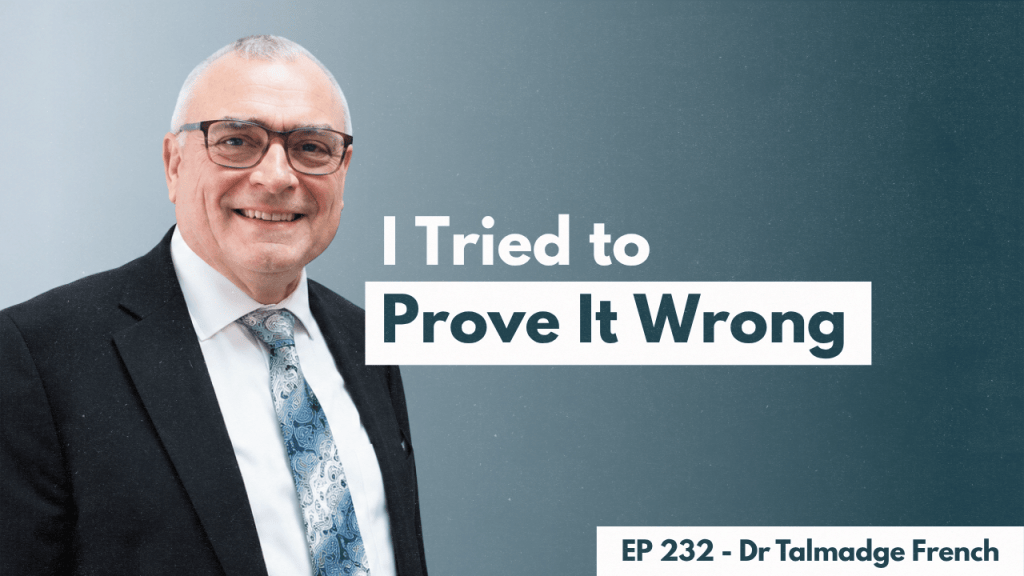
Every once in a while, I have a conversation on the podcast that I wish could have gone for another two or three hours. My conversation with Dr. Talmadge French was one of those.
Dr. French has spent decades studying Scripture, biblical languages, theology, and the history of the Oneness Pentecostal movement. He holds four degrees, including a PhD, has extensively studied Greek, Hebrew and Latin, has taught in Bible colleges, pastored churches, and written significant works documenting the history and worldwide reach of Oneness Pentecostalism.
What makes his story especially interesting, however, is that he wasn’t raised believing the Oneness message.
Dr. French came from a Trinitarian Pentecostal background. As a young man, he heard a United Pentecostal Church radio broadcast called Harvest Time that challenged him to consider something he had never seriously confronted before: throughout the book of Acts, people were baptized in the name of Jesus Christ.
He didn’t immediately accept it. In fact, he began trying to prove it wrong.
That search ultimately led him in the opposite direction.
After years of wrestling with Scripture, he reached the point where he felt he had to be baptized in Jesus’ name. That decision changed the trajectory of his life and ministry.
What I appreciated about this conversation was that Dr. French doesn’t see serious scholarship and Apostolic revival as opposing forces. His life has been an attempt to bring the two together. He believes we can study deeply, engage seriously with biblical languages and history, and still maintain a passionate dependence upon the Holy Ghost and the supernatural work of God.
As he put it, without the power of the Spirit, a move of God and a Book of Acts reality, “we’re not very apostolic.”
That idea runs throughout our entire conversation.
10 Key Takeaways
1. Don’t Be Afraid to Study Deeply
Dr. French encouraged young Apostolics not to “sell yourself short.” Serious study doesn’t have to weaken our spirituality. When submitted to God, education can sharpen our understanding of Scripture and make us better communicators of truth.
2. Revival and Scholarship Belong Together
Dr. French described his calling as a “marriage of revival and academia.” We shouldn’t have to choose between knowing the Word deeply and experiencing the power of the Holy Ghost. The Apostolic church needs both.
3. Scripture Has to Have the Final Word
Dr. French didn’t set out to become Oneness, he initially tried to prove the message false. Eventually, he became convinced by Scripture that he needed to be baptized in Jesus’ name. His story challenges all of us to remain willing to follow Scripture even when it confronts what we’ve always believed.
4. The Oneness Movement Is Bigger Than We Realise
Dr. French’s ongoing research has identified more than 800 Oneness organizations worldwide. His current estimate places the global Oneness movement at around 40 million believers. Whether we realise it or not, we’re part of something much larger than our individual organisations.
5. The Biblical Case for Oneness Begins With One God
Dr. French continually returned to the biblical declaration that God is one. From the Old Testament through the incarnation revealed in John, his argument is that Scripture presents Jesus as the one God revealed in flesh.
6. Biblical Languages Are Worth Studying
After decades studying Greek, Hebrew and Latin, Dr. French believes the original languages strengthen rather than weaken the Apostolic position. We shouldn’t be intimidated when someone says, “The Greek actually says…” We should be willing to study it ourselves.
7. Church History Matters
Our conversation explored the development of Trinitarian terminology and Dr. French’s research into early Christianity. Church history helps us distinguish between what Scripture actually says and theological language that developed in later centuries.
8. Conviction Doesn’t Require Hostility
We can strongly believe and defend Apostolic doctrine without becoming combative. The way we communicate truth matters. Our conversations should demonstrate the same fruit of the Spirit we preach about.
9. Oneness Pentecostals Need Greater Unity
One of Dr. French’s biggest questions after decades of studying the movement is why Oneness Pentecostals around the world aren’t more connected. We can maintain our convictions while still finding ways to recognise and build relationships with others who share this Apostolic faith.
10. God Can Get Truth Anywhere
Dr. French’s remarkable encounter with a Tibetan monk who was preaching Acts 2:38 reminded me that God isn’t limited by geography, organizations or human strategy. There is nowhere beyond God’s ability to reach.
Scriptures Discussed
Deuteronomy 6:4 — The foundational declaration of the Shema: “The LORD our God, the LORD is one.”
Matthew 28:19 — Jesus’ command to baptize “in the name of the Father and of the Son and of the Holy Spirit,” discussed in connection with Jesus Name baptism.
John 1:1 — “In the beginning was the Word, and the Word was with God, and the Word was God.”
John 1:14 — “And the Word became flesh and dwelt among us.” A key passage in the discussion of the incarnation.
John 5:18 — Discussed in connection with Jesus making Himself equal with God.
Acts 2:38 — Peter’s command to repent and be baptized in the name of Jesus Christ and receive the gift of the Holy Ghost.
Acts 8:16 — Referenced as part of the New Testament pattern of baptism in the name of the Lord Jesus.
Acts 10:48 — Peter commands the Gentile believers to be baptized in the name of the Lord.
Acts 11 — Referenced during the discussion of Jesus, salvation and the early church.
Acts 19:5 — The Ephesian believers are baptized in the name of the Lord Jesus.
Hebrews 2:14 — Referenced in the discussion of God partaking of flesh and blood through the incarnation.
Final Thought
One of the things that stayed with me most from this conversation was simply how much larger the Oneness movement is than most of us realise.
It’s easy to view the Apostolic movement through the lens of our own church, organisation, or part of the world. But Dr. French’s decades of research paint a much bigger picture. With more than 800 Oneness organisations identified and his current estimate of around 40 million believers worldwide, there are people across nations and cultures embracing the Oneness of God, being baptised in Jesus’ name, and experiencing the infilling of the Holy Ghost.
The story of the Tibetan monk captured this beautifully for me. Here was someone preaching Acts 2:38 and baptising people in Jesus’ name without even realising there was a worldwide movement of believers who shared those same convictions.
It reminded me that what God is doing is so much bigger than what any one of us can see. But I also think this conversation should challenge us. We need greater awareness of one another, greater connection across organisational and geographical lines, and a greater appreciation for what God is doing around the world.
The Oneness movement is bigger than most of us understand, and I believe there is still so much more for us to discover.
Connect with us on social:
Instagram: @thehackapodcast
Facebook: The Hacka Podcast
YouTube: Subscribe Here



Leave a comment